

Temple of Hatshepsut
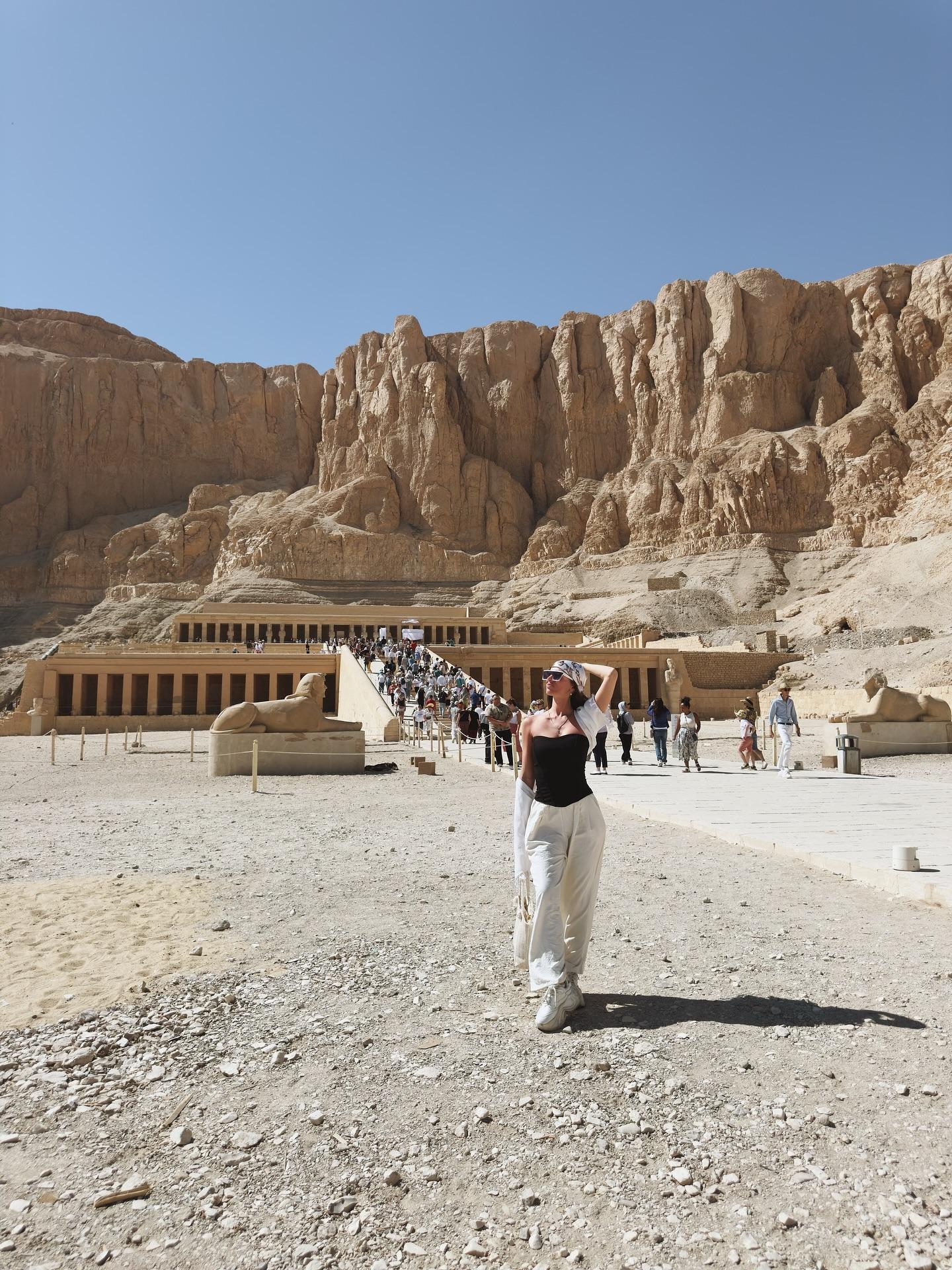
The Temple of Hatshepsut, also known as the Mortuary Temple of Hatshepsut, is one of the most magnificent architectural masterpieces of ancient Egypt. Nestled beneath the dramatic limestone cliffs of Deir el-Bahari on Luxor's West Bank, the temple is celebrated for its elegant terraces, grand colonnades, and harmonious design that blends seamlessly with the surrounding landscape.
Built during the 18th Dynasty around 1479–1458 BC, the temple was commissioned by Queen Hatshepsut, one of the most successful and influential rulers in Egyptian history. Unlike many royal monuments dedicated to male pharaohs, this remarkable temple reflects the achievements of a powerful female king who ruled Egypt during a period of peace, prosperity, and ambitious building projects.
The temple served as both Hatshepsut's mortuary temple and a sacred place dedicated to the god Amun-Ra. Its walls are richly decorated with reliefs depicting religious ceremonies, the queen's divine birth, and the famous expedition to the mysterious Land of Punt, one of the greatest trading missions of the ancient world.
Today, the Temple of Hatshepsut is one of the most visited attractions in Luxor and a highlight of many Luxor Tours, Nile Cruise Packages, and Egypt Tour Packages. Visitors are captivated by its distinctive architecture, fascinating history, and breathtaking setting against the towering cliffs of western Thebes.
Recognized as part of the UNESCO World Heritage Site of Ancient Thebes and its Necropolis, the temple offers an unforgettable experience for anyone interested in ancient Egyptian history, architecture, or archaeology. Whether you're exploring Luxor on a Private Egypt Tour or enjoying a luxury Nile Cruise Package, the Temple of Hatshepsut is an essential stop on your journey through Egypt.
History of the Temple of Hatshepsut
The Temple of Hatshepsut was constructed during the reign of Queen Hatshepsut, one of the few women to rule ancient Egypt as pharaoh. After the death of her husband, Thutmose II, Hatshepsut initially served as regent for the young Thutmose III. Within a few years, she assumed the full title and authority of pharaoh, wearing the traditional royal regalia and presenting herself as the legitimate ruler of Egypt.
Her reign marked one of the most prosperous and peaceful periods of the New Kingdom. Rather than focusing on military conquest, Hatshepsut invested heavily in trade, diplomacy, monumental architecture, and economic development. Among her greatest achievements was the construction of her magnificent mortuary temple at Deir el-Bahari.
The temple was designed by her trusted architect and royal official Senenmut, who created a masterpiece unlike any other temple in Egypt. Instead of towering pylons and enclosed courtyards, the complex features three elegant terraces connected by broad ramps, creating a graceful transition between the desert plain and the towering cliffs behind it.
One of the temple's most famous reliefs illustrates the Expedition to the Land of Punt, where Egyptian ships returned with incense trees, exotic animals, ivory, ebony, gold, and other valuable goods. These scenes provide historians with one of the earliest detailed records of international trade in the ancient world.
Other reliefs depict Hatshepsut's Divine Birth, presenting her as the daughter of the god Amun-Ra. This powerful religious narrative reinforced her legitimacy as pharaoh and strengthened her position in a society traditionally ruled by men.
After Hatshepsut's death, many of her statues and inscriptions were damaged or removed, likely during the reign of Thutmose III. Despite these attempts to erase her memory, the temple itself survived and remains one of Egypt's finest examples of New Kingdom architecture.
Today, careful archaeological excavations and restoration projects have preserved much of its original beauty, allowing visitors to admire one of the greatest monuments ever built by an ancient Egyptian ruler.
Architecture and Design
The Temple of Hatshepsut is widely regarded as one of the finest architectural achievements of ancient Egypt. Unlike traditional Egyptian temples, which feature massive pylons and enclosed courtyards, Hatshepsut's temple was designed in perfect harmony with the towering limestone cliffs of Deir el-Bahari. Its elegant symmetry, spacious terraces, and graceful colonnades make it one of the most distinctive monuments in the country.
Designed by the royal architect Senenmut, the temple combines natural beauty with remarkable engineering. The three ascending terraces are connected by broad central ramps, creating a dramatic visual effect that draws visitors toward the sanctuary at the rear of the complex. This innovative design has inspired architects and historians for generations and remains one of the highlights of many Luxor Tours, Egypt Tour Packages, and Private Egypt Tours.
Constructed primarily from fine limestone, the temple originally featured brightly painted reliefs, colorful statues, and beautifully decorated walls. Although time has faded much of the original color, many carvings remain remarkably well preserved, providing valuable insights into the reign of Queen Hatshepsut.
The Three Terraces
One of the temple's most striking features is its three magnificent terraces, each connected by a wide ceremonial ramp.
First Terrace
The lowest terrace originally featured beautiful gardens filled with trees, flowering plants, and pools of water. Historical evidence suggests that exotic incense trees brought back from the Land of Punt were planted here, creating a lush entrance unlike any other temple in Egypt.
Visitors approaching the temple today can still appreciate its impressive scale and perfectly balanced proportions.
Second Terrace
The second terrace contains some of the temple's most famous reliefs. Here, visitors can admire scenes illustrating Hatshepsut's successful trading expedition to Punt, one of the greatest commercial achievements of the New Kingdom.
This level also includes elegant colonnades decorated with statues of Queen Hatshepsut depicted as both a traditional female ruler and a male pharaoh wearing the royal nemes headdress and ceremonial beard.
Third Terrace
The upper terrace formed the sacred heart of the temple. It contains the sanctuary dedicated to Amun-Ra, along with several important chapels and ceremonial rooms where priests performed religious rituals in honor of the queen and the gods.
From the upper terrace, visitors enjoy breathtaking panoramic views across Luxor's fertile Nile Valley, making it one of the best viewpoints on the West Bank.
The Chapel of Amun-Ra
At the center of the upper terrace lies the Chapel of Amun-Ra, the principal sanctuary of the temple.
Dedicated to Egypt's supreme deity during the New Kingdom, the chapel served as the destination of sacred processions during important religious festivals, particularly the Beautiful Festival of the Valley, when the statue of Amun crossed the Nile from Karnak Temple to visit the temples of the west bank.
Only priests and members of the royal family were permitted to enter the innermost sanctuary, where daily rituals, offerings, and prayers were performed.
Today, visitors can admire the beautifully carved reliefs that still decorate many of the chapel's walls.
The Chapel of Hathor
Another remarkable part of the complex is the Chapel of Hathor, dedicated to the goddess of love, music, beauty, motherhood, and joy.
The chapel is easily recognized by its elegant columns decorated with Hathor-headed capitals, one of the most distinctive architectural features found in ancient Egyptian temples.
Its walls depict Queen Hatshepsut receiving blessings from Hathor, emphasizing the close relationship between the goddess and the ruling pharaoh.
The chapel also contains beautifully preserved scenes showing religious ceremonies, musicians, dancers, and offerings presented to the goddess.
The Chapel of Anubis
Located on the northern side of the upper terrace, the Chapel of Anubis honors the jackal-headed god associated with embalming, mummification, and the protection of the dead.
Its colorful reliefs portray Anubis welcoming and protecting Queen Hatshepsut during her journey into the afterlife.
Although smaller than the main sanctuary, the chapel remains one of the temple's finest preserved religious spaces.
The Expedition to the Land of Punt
Perhaps the most famous reliefs within the Temple of Hatshepsut depict the legendary Expedition to the Land of Punt.
These remarkable carvings illustrate a diplomatic and commercial expedition organized during Hatshepsut's reign to obtain valuable luxury goods unavailable in Egypt.
The reliefs show Egyptian ships sailing across the Red Sea before returning with extraordinary treasures, including:
- Frankincense and myrrh trees.
- Gold.
- Ebony wood.
- Ivory.
- Exotic animals.
- Incense.
- Precious resins.
- Rare plants
These scenes provide historians with one of the oldest surviving records of international trade and demonstrate the prosperity achieved during Hatshepsut's peaceful reign.
Many visitors exploring the temple as part of Luxor Tours or Egypt Tour Packages consider the Punt reliefs among the most fascinating artistic masterpieces of ancient Egypt.
The Divine Birth Reliefs
Another extraordinary series of reliefs illustrates the Divine Birth of Queen Hatshepsut.
According to these inscriptions, the god Amun-Ra visited Hatshepsut's mother and declared that their daughter was destined to become Egypt's rightful ruler.
These scenes were carefully designed to strengthen Hatshepsut's legitimacy as pharaoh, presenting her reign as the will of the gods rather than simply a political decision.
The reliefs remain among the finest examples of royal religious propaganda from ancient Egypt.
Senenmut: The Mastermind Behind the Temple
The Temple of Hatshepsut was designed by Senenmut, one of the most talented architects and officials of the New Kingdom.
Serving as royal steward, tutor to Princess Neferure, and chief architect, Senenmut supervised numerous construction projects during Hatshepsut's reign.
His innovative design for Deir el-Bahari transformed the natural landscape into an architectural masterpiece that continues to impress visitors more than 3,400 years later.
Many Egyptologists regard Senenmut as one of the greatest architects in ancient Egyptian history.
Interesting Facts About the Temple of Hatshepsut
- The temple was built around 1479–1458 BC during Egypt's 18th Dynasty.
- It was designed by the famous architect Senenmut.
- Queen Hatshepsut was one of the few women to rule ancient Egypt as pharaoh.
- The temple is built directly against the cliffs of Deir el-Bahari, creating one of Egypt's most dramatic architectural landscapes.
- The famous Punt Expedition reliefs provide one of history's earliest detailed records of international trade.
- The temple formed part of the annual Beautiful Festival of the Valley, when the sacred barque of Amun-Ra traveled from Karnak Temple.
- It is one of the best-preserved mortuary temples in Egypt.
- Today, it remains one of the most visited attractions included in Luxor Day Tours, Nile Cruise Packages, and Egypt Tour Packages.
Planning Your Visit to the Temple of Hatshepsut
A visit to the Temple of Hatshepsut is one of the highlights of exploring Luxor's West Bank. Surrounded by the towering cliffs of Deir el-Bahari, this magnificent temple combines breathtaking architecture with fascinating history, making it one of Egypt's most visited archaeological sites.
Many travelers visit the temple as part of a Luxor Day Tour, Private Luxor Tour, or Egypt Tour Package, often combining it with the Valley of the Kings, the Colossi of Memnon, and Karnak Temple. It is also a popular excursion included in many Nile Cruise Packages, allowing visitors to discover the remarkable legacy of Queen Hatshepsut.
Opening Hours
The Temple of Hatshepsut is open daily throughout the year.
Summer (April – September)
6:00 AM – 6:00 PM
Winter (October – March)
6:00 AM – 5:00 PM
Opening hours may change during public holidays or Ramadan, so checking the latest schedule before your visit is recommended.
Ticket Information
An entrance ticket is required to visit the Temple of Hatshepsut.
Tickets can be purchased at the official ticket office, and prices are updated periodically by the Egyptian authorities.
Many Luxor Tours, Private Egypt Tours, and Nile Cruise Packages include transportation, entrance arrangements, and the services of a professional Egyptologist guide, making your visit smooth and informative.
Best Time to Visit
The best time to visit the Temple of Hatshepsut is between October and April, when the weather is cooler and more comfortable for sightseeing.
For the best experience:
- Arrive early in the morning.
- Visit before large tour groups arrive.
- Allow 1–2 hours to explore the temple.
- Combine your visit with nearby attractions on Luxor's West Bank.
Early morning also provides the best lighting for photography, highlighting the temple's limestone terraces against the dramatic cliffs.
How to Get There
The Temple of Hatshepsut is located at Deir el-Bahari on Luxor's West Bank, approximately 6 kilometers (4 miles) from the Valley of the Kings.
Visitors can reach the temple by:
- Private transfer
- Taxi
- Organized Luxor Tours
- Private Egypt Tours
- Excursions included in Nile Cruise Packages
Most visitors combine the temple with a full-day West Bank tour that includes several nearby archaeological sites.
Photography Tips
The Temple of Hatshepsut offers some of the finest photography opportunities in Luxor.
For the best photos:
- Visit shortly after sunrise.
- Capture the three terraces from the entrance.
- Photograph the temple against the cliffs of Deir el-Bahari.
- Explore different angles from the upper terraces.
- Use a wide-angle lens to capture the temple's impressive scale.
Photography policies inside certain areas may vary, so always follow the instructions of site staff.
Visitor Tips
To enjoy the best experience:
Wear comfortable walking shoes.
Bring sunscreen, sunglasses, and a hat.
Carry bottled water, especially during summer.
Respect archaeological barriers.
Do not touch the ancient reliefs or statues.
Hire a licensed Egyptologist guide to understand the temple's fascinating history and symbolism.
Allow enough time to admire the detailed carvings and panoramic views.
Nearby Attractions
The Temple of Hatshepsut is surrounded by some of Egypt's most famous archaeological sites.
The legendary burial place of New Kingdom pharaohs, including the famous Tomb of Tutankhamun.
Colossi of Memnon
Two colossal statues of Pharaoh Amenhotep III that have stood on Luxor's West Bank for more than 3,400 years.
Medinet Habu
The magnificent mortuary temple of Ramses III, renowned for its beautifully preserved reliefs and colorful carvings.
Valley of the Queens
The royal burial place of queens and princes, including the spectacular Tomb of Queen Nefertari.
The largest religious complex ever built, located on Luxor's East Bank.
One of Egypt's most beautiful temples, connected to Karnak by the historic Avenue of Sphinxes.
Conclusion
The Temple of Hatshepsut stands as a remarkable tribute to one of ancient Egypt's most visionary rulers. Its elegant terraces, beautifully preserved reliefs, and dramatic setting beneath the cliffs of Deir el-Bahari make it one of the most impressive monuments in Luxor. Beyond its architectural beauty, the temple tells the story of Queen Hatshepsut's successful reign, her ambitious building projects, and her famous trading expedition to the Land of Punt.
For the best experience, combine your visit with the Valley of the Kings, Karnak Temple, Luxor Temple, Colossi of Memnon, Medinet Habu, and the Valley of the Queens to gain a deeper understanding of the history of ancient Thebes.
Our expertly designed Luxor Tours, Private Egypt Tours, Egypt Tour Packages, and Luxury Egypt Tours include the Temple of Hatshepsut as part of carefully planned itineraries led by professional Egyptologist guides. If you're exploring Upper Egypt, many of our Nile Cruise Packages also include this extraordinary temple, allowing you to experience one of the greatest architectural masterpieces of the ancient world while discovering the timeless wonders of the Nile Valley.